
THE LAW OF THE STRONGEST: ABSOLUTIST DEMOCRACY

The capture of Nicolás Maduro on January 3, 2026, was not just an international police operation; it was the funeral of the rules-based liberal international order. We have entered an era of hyperrealism , where military power and control of resources dictate the law. Who governs? Washington, through modern viceroys (Rubio, Hegseth). Who pays? Venezuelan oil. Is it fair? No, but in Trump's new order, justice is a luxury that is subordinated to "Business" and "Power".
The world is not heading towards a global community, but towards vast walled imperial fortresses, where great powers manage their backyards with an iron fist, and where figures like Maria Corina Machado, armed only with moral legitimacy and Nobel Prizes, are seen as irrelevant inconveniences on the grand chessboard of hard power.

Global Strategic Report: The New Hemisphere Doctrine and the Reconfiguration of the World Order
What the world witnessed in Caracas was not simply a precision military incursion; it was the first act of a new geopolitical script. Just days after the capture of Nicolás Maduro, the United States government sealed this new stance by announcing its withdrawal from 66 international organizations and treaties, including 31 UN entities

This two-pronged approach—the unilateral use of force and the dismantling of diplomatic restraints—places us in an era that could well be defined as that of "Absolute Democracies." If in the past monarchies invoked divine right to act without limits, today we see how the legitimacy of the ballot box is transformed into a mandate to ignore international law and global checks and balances when these clash with national interests.
The intervention in Venezuela is the field test of this new paradigm: an operation executed without the permission of multilateral organizations, under a logic of absolute sovereignty that prioritizes effectiveness over traditional diplomacy.
For those of us who lead organizations and analyze senior management, understanding this shift is vital: the rules of stability we once knew have been replaced by strategic volatility where force and opportunity dictate the course.
In this article, we analyze the implications of this intervention, not only as a historical event in Venezuela, but also as the definitive symptom of a world that has ceased to be moderate and has become, once again, absolutist.
1. The Collapse of the Chavista State and the Dawn of the Era of Direct Intervention

The early morning of January 3, 2026, will undoubtedly mark a definitive turning point in the geopolitical history of the 21st century. The execution of the US military operation that culminated in the capture of Venezuelan President Nicolás Maduro and First Lady Cilia Flores at the Fuerte Tiuna military complex not only represents the end of a regime that dominated Venezuelan politics for more than a decade, but also inaugurates a new architecture of security and power in the Western Hemisphere.
This event, which President Donald Trump described as a "full-scale attack" carried out in conjunction with elite security and military forces such as Delta Force, transcends the mere neutralization of a political adversary; it symbolizes the explicit dismantling of the Westphalian norms of sovereignty that had governed inter-American relations, replacing them with a policy of brute force and direct imperial administration.
The operation, characterized by its surgical precision and the overwhelming technological superiority deployed over Caracas, stunned the international community. As Venezuelan air defense systems were neutralized and explosions rocked the capital, the Chavista command structure crumbled with a speed that exposed the inherent fragility of a system corroded by corruption and social disconnection.
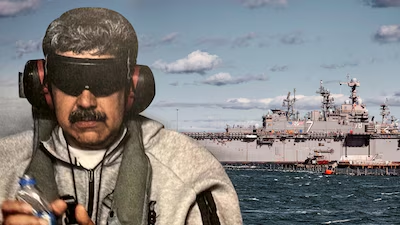
The image of Nicolás Maduro aboard the USS Iwo Jima, disseminated by President Trump himself through Truth Social, was not just proof of life or a war trophy; it was a calculated visual message directed at all political actors on the continent, from Bogotá to Brasilia, signaling that sovereign immunity is no longer a guarantee against the national security interests of the United States.
This report, which I am pleased to present here, analyzes the multiple dimensions of this seismic event:
The implications of the "Business First" doctrine announced by Trump will be broken down.
The ethical and political controversy of dismissing 2025 Nobel Peace Prize winner María Corina Machado in favor of a US trusteeship
The existential question of whether this event confirms the division of the world into exclusive spheres of influence between the great powers.
Through a detailed analysis of the facts, official statements, and historical context, we will seek to answer critical questions about who will govern Venezuela, who will pay the cost of this war, and what the true strategic benefit is for the United States in this new global scenario.
1.1 The Operational Context: From Pressure to Decapitation

The capture of Maduro was not an isolated event, but the culmination of months of escalating US pressure, which included the interception of oil tankers and attacks on maritime drug trafficking routes.
The decision to execute a “decapitation” operation—similar in tactics but larger in scale to the 1989 invasion of Panama that deposed Manuel Noriega—reflects a shift in Washington’s risk assessment. The Trump administration, armed with a 2020 indictment for narcoterrorism against the Venezuelan leadership, opted to bypass diplomatic channels and traditional economic sanctions, which had proven insufficient to dislodge Chavismo, in favor of a direct, kinetic intervention.
The paralysis of the Bolivarian National Armed Forces (FANB), unable to mount a coherent defense or counterattack, suggests that the operation also involved a significant component of psychological and cyber warfare that left the high command loyal to Maduro blind.
2. The "Business First" Doctrine: Decoding Trump's Economic Strategy
One of President Trump's most enigmatic and revealing statements after the capture was his assertion that "the first objective is business, and then the well-being of Venezuelans." This phrase, far from being a rhetorical slip, encapsulates the central philosophy of the intervention and dismantles the traditional humanitarian narrative that usually accompanies Western interventions.
2.1 The Decoupling of Well-being and the Prioritization of Solvency

The underlying premise of Trump's statement is that the humanitarian crisis in Venezuela is not a cause, but a symptom of the collapse of the national business model: the oil industry. In the Trump administration's view, "well-being" cannot be delivered through humanitarian aid or subsidies, but must be generated by a functioning economy. Since Venezuela is a petrostate, "functioning" is synonymous with the efficient extraction and export of crude oil.

By putting "business" first, Trump establishes a pragmatic and brutally capitalist roadmap:
Asset Stabilization
The immediate priority is not food distribution, but the physical security of oil fields, refineries, and export ports.
Reactivation of Cash Flows
Only through the sale of oil at market prices, managed by competent entities (i.e., US corporations), can the Venezuelan state regain revenue.
Economic Trickle-Down
The well-being of the population is seen as an eventual side effect of the macroeconomic recovery led by the US private sector.
2.2 The Role of US Oil Companies and Reconstruction
Trump was explicit in detailing that US oil companies—"the largest in the world"—would enter Venezuela to "fix the severely broken infrastructure." This implies a de facto and accelerated privatization of the Venezuelan state oil company, PDVSA, which under Chavismo had suffered chronic degradation due to lack of investment and corruption.
Aspect | Chavista Model (Previous) | Trump Model (Proposed 2026) |
Management | State-owned (PDVSA) with political control | Private (US Majors) under military supervision |
Aim | Financing of social programs and regional diplomacy | Maximizing production and debt repayment |
Sovereignty | Strategic national resource | Asset under US trust management |
Infrastructure | Degraded, technological obsolescence | Rapid modernization with foreign capital |
The announcement that these companies "will begin making money for the country" suggests that a concession or joint venture model highly favorable to foreign companies will be implemented, reversing decades of resource nationalism. For Trump, the entry of ExxonMobil, Chevron, and others is not a corporate invasion, but a rescue operation of assets that, according to his narrative, were "stolen" from the United States through past expropriations.
2.3 Who Will Pay the Cost of the War?

To the crucial question about the financing of the conflict and the subsequent occupation, Trump's answer introduces a model of self-financed intervention.
He stated that the reconstruction costs and, implicitly, the operating costs of stabilization, would be "paid by the oil companies directly" or deducted from the revenue generated by Venezuelan oil.
This reflects the transactional logic of "America First." The American taxpayer will not finance the reconstruction of Venezuela; the Venezuelan subsoil will.
Payment Mechanism
A trust controlled by the U.S. Treasury Department will likely be established, into which the proceeds from oil sales will be deposited. From this fund, the costs of military operations, payments to U.S. contractors responsible for infrastructure, and debt service will be deducted before releasing funds for the Venezuelan national budget.
Implications: This turns Venezuela into an economically vassal state during the transition period, where its natural resources are mortgaged to pay for its own "liberation".
3. The Governance Dilemma: Who Will Rule in Venezuela?

Uncertainty over who will occupy Miraflores Palace is one of the central tensions following the takeover. The international community and the Venezuelan opposition expected an immediate transfer of power to the election winner or the movement's moral leader. However, the reality imposed by Washington is radically different.
3.1 The Discard of María Corina Machado and Edmundo González

The figures of María Corina Machado, awarded the Nobel Peace Prize in 2025 for her tireless fight for democracy, and Edmundo González Urrutia, recognized by much of the world as the legitimate winner of the 2024 elections, presented the logical path for a democratic transition. Machado, from exile or hiding, declared that the "hour of freedom" had arrived and called on González to assume his constitutional mandate.
Why discard them?
Perceived Weakness
The Trump administration appears to believe that the traditional opposition, despite its moral legitimacy, lacks the coercive power necessary to purge the Chavista deep state, control armed groups, and stabilize the country. Trump, who values force over legality, views the civic opposition as incapable of managing the post-Maduro chaos.
Total Control
Installing a sovereign government led by Machado would entail negotiating the terms of oil reconstruction and the military presence. A Machado government, imbued with democratic legitimacy and European support (Nobel Prize), could resist the predatory conditions imposed by US oil companies or an indefinite military presence.
The "MacArthur Doctrine"
Trump seems to prefer a model of direct military occupation, similar to General MacArthur's administration of Japan after World War II, where structural reforms are imposed from an unquestionable occupying authority before allowing democratic political play.
3.2 The "Trusteeship" (Protectorate) Model

Instead of a Venezuelan president, Trump announced that the United States would "run the country" temporarily. This de facto interim government will not be a Venezuelan civilian administration, but rather an authority led by a "group" of high-level U.S. officials.
The Occupation Troika
Trump specifically mentioned hardliners such as Secretary of State Marco Rubio, Secretary of Defense Pete Hegseth, and Chairman of the Joint Chiefs of Staff Gen. Dan Caine to oversee the transition.
Marco Rubio: As a political architect, he ensures that the transition eliminates any vestige of Cuban or socialist influence.
Pete Hegseth and Gen. Caine: They ensure military control of the territory and the protection of critical infrastructure.
This approach effectively turns Venezuela into a US protectorate for an indefinite period, until a "safe, adequate and judicious" transition is deemed to exist.
Venezuelan sovereignty is suspended in favor of hemispheric security and economic reconstruction directed by Washington.
4. The "Donroe Doctrine": The Return of the Fortress Hemisphere

Trump's reference to the Monroe Doctrine during his press conference was not a historical anachronism, but the proclamation of a renewed and aggressive foreign policy, dubbed by himself and his advisors as the "Trump Corollary" or, colloquially, the "Donroe Doctrine".
4.1 What did he mean by the Monroe Doctrine?

The original Monroe Doctrine of 1823 stated that any intervention by European powers in the Americas would be seen as an act of aggression against the United States. Trump has updated and expanded this concept for the 21st century.
Total Exclusion of Rivals
It's no longer just about European colonial empires, but also about China, Russia, and Iran. Maduro's capture is a direct message of expulsion for Russian military advisors and Chinese state investments in the region. Trump declared that "American dominance in the Western Hemisphere will never again be challenged."
Right to Preemptive Intervention
The "Trump Corollary" assumes that the United States has the inherent right to intervene militarily in any nation in the hemisphere that is considered a "bad neighbor" or that harbors foreign adversaries, without the need for multilateral approval (OAS or UN).
4.2 The Threat to Colombia and the Concept of "Good Neighbors"

When Trump stated that "we want to surround ourselves with good neighbors," he defined neighborliness not by geography, but by political alignment.
The explicit threat to Colombian President Gustavo Petro —"He should watch his backside"— accompanied by accusations about cocaine factories, demonstrates that the Donroe Doctrine does not stop at Venezuela's borders.
The Domino Effect
The fall of Maduro and the threat to Petro are intended to discipline the entire region. The message is clear:
US tolerance of "pink tide" or progressive left-wing governments that flirt with China or tolerate drug trafficking is over. National sovereignty is subordinated to US security interests (drug trafficking, migration, energy).
Monroe Doctrine (1823) | "Donroe" Doctrine (2026) |
Approach | Defensive (Prevent recolonization) |
Adversary | European Imperial Powers |
Mechanism | Diplomatic and Naval (Deterrence) |
Economy | Free Trade |
5. The Real Benefit for the United States: Interest Analysis

To the question, "What is the real benefit of the US?", the answer transcends the rhetoric of freedom and democracy. The strategic benefits are tangible, massive, and calculated for the long term.
5.1 Energy Security and Resource Hegemony
Venezuela possesses the world's largest proven oil reserves. By placing these reserves under the management of US companies and US military protection, Washington achieves the following:
Middle Eastern Independence
It reduces global vulnerability to crises in the Persian Gulf. An energy self-sufficient Western Hemisphere is a "Fortress America."
Price control
The ability to directly influence Venezuelan production gives the US immense power over global energy markets, counteracting OPEC+.
5.2 Strategic Denial of China
China had turned Venezuela into a beachhead in Latin America, investing billions and securing crude oil supplies in exchange for debt. Trump's intervention:
Cancel China's Debt
A US-led transitional government could declare debt owed to China odious or prioritize Western creditors, inflicting a financial blow on Beijing.
Eliminate the Russian Military Presence
It removes Russian intelligence and military assets from the US "backyard," closing a critical security vulnerability.
5.3 Internal Policy and Migration
Controlling Venezuela allows Trump to attack the root of one of the largest migration crises in the hemisphere. By stabilizing (by force) the country and reviving its economy, he hopes to stem the flow of refugees to the U.S. southern border, fulfilling a key campaign promise.
6. Ethics and Justice: The Case of María Corina Machado

Was it "fair and right" for Trump to dismiss María Corina Machado? The answer depends on the ethical lens used.
6.1 The Perspective of Democratic Justice (Unjust)
From the perspective of democratic values and international law, this action is profoundly unjust. Machado and her coalition followed the rules, mobilized the citizenry, won at the polls, and earned international recognition (the Nobel Prize). To dismiss this is a betrayal of the principles of self-determination. It suggests that the Venezuelan vote is irrelevant and that only U.S. military force confers legitimacy. It transforms Venezuela from a domestic dictatorship into an imperial possession.
6.2 The Realistic Perspective (Correct according to Trump)
From the Machiavellian logic and the "Offensive Realism" that guides Trump, the decision is "correct." For him, justice is secondary to effectiveness. Machado represents an idealism that failed to remove Maduro for years. Trump prioritizes an administrator who will obey direct orders from Washington to secure oil and security, without the "inconveniences" of sovereign politics or the nationalism that Machado might represent. It is a decision based on utility, not morality.
7. The Division of the World? Towards a New Strict Bipolar Order

The final questions touch on the central nerve of future geopolitics: Have the great powers divided up the world? Are we heading towards one president for the Americas and another for the East?
7.1 Confirmation of the Spheres of Influence
The reaction (or lack thereof) from Russia and China to the capture of Maduro strongly suggests a tacit agreement on "spheres of influence".
The Silence of the East
Although Russia called the act an "aggression" and China demanded the lifting of sanctions, no major power mobilized forces to defend Maduro. This indicates that Beijing and Moscow recognize, de facto, that the Western Hemisphere is a US exclusion zone.
The "Grand Bargain"
Analysts suggest this could be part of a broader understanding. The United States consolidates its presence in the Americas without interference, and in return, could reduce its pressure in areas of vital interest to China (Taiwan/South China Sea) or Russia (Ukraine/Eastern Europe).
7.2 One World, Two Systems, Two Presidents
The vision of a "President for America" (USA) and a "President for the Eastern Hemisphere" (China) is not far-fetched in this context.
The Western Bloc
Under the Donroe Doctrine, Latin American presidents become regional governors with limited autonomy, subordinate to Washington's security and economic directives. The OAS becomes irrelevant in the face of direct command from the White House.
The Eastern Bloc
China and Russia are consolidating their control over Eurasia and Africa through the Belt and Road Initiative and military alliances, creating a parallel economic and political system immune to the dollar and the marines.
7.3 Conclusion: The End of the Liberal Order
The capture of Nicolás Maduro on January 3, 2026, was not just an international police operation; it was the funeral of the rules-based liberal international order. We have entered an era of hyperrealism , where military power and control of resources dictate the law.
Who governs? Washington, through modern viceroys (Rubio, Hegseth).
Who pays? Venezuelan oil.
Is it fair? No, but in Trump's new order, justice is a luxury that is subordinated to "Business" and "Power".
The world is not heading towards a global community, but towards vast walled imperial fortresses, where great powers manage their backyards with an iron fist, and where figures like Maria Corina Machado, armed only with moral legitimacy and Nobel Prizes, are seen as irrelevant inconveniences on the grand chessboard of hard power.


Comments