
CHANGE IS NOT A "GIFT", IT IS A STRATEGIC DECISION

Who runs your life? Your Reptilian Brain or your Inner CEO? In the corporate world, we invest millions in external strategy, but we forget about internal strategy.
Neuroscience is clear: under stress, your primitive brain (fear/reaction) takes over. The result is poor decisions, weak leadership, and stagnation. But I have good news: neuroplasticity works in our favor.
In this article, I explain it step by step: 1️⃣ The critical difference between Hard and Soft Skills (and why the latter are what get you promoted). 2️⃣ Jill Bolte Taylor's 90-second rule for stopping an emotional meltdown. 3️⃣ How to activate your Neocortex to think clearly under pressure. It's not self-help; it's biology applied to high performance.

The Trap of "Genius and Figure"
Popular sayings are often broken compasses: they guide us with half-truths. The fatalistic belief that "Once a genius, always a genius" still prevails in our culture. This saying condemns us to believe that we are determined from childhood by our genetics, our physical limitations, or our social environment.
However, today I come to tell you that this is a lie . Modern science, specifically neuroscience , has given us the key to freeing ourselves from that prison: the ability to change is not a miracle, it is a biological function that we can activate at will.
Neuroscience: The End of Determinism

Joaquim Fuster , eminent researcher and professor at UCLA, in his work "The Magic Loom of the Mind" , reveals to us that the neural network —and specifically the neocortex— is the basis of all knowledge and memory.
Herein lies the secret: the brain is not static; it is plastic. It is formed and reshaped through experience and the connections we choose to establish. Fuster teaches us that consciousness resides in this neural network.
The brain operates holistically . Imagine a symphony orchestra: we cannot understand Beethoven's Ninth Symphony by analyzing the chemical composition of the violin wood. The music arises from the coordinated interaction between the musicians (the neurons). To change, we need the conductor of that orchestra (our conscious will) to take up the baton.
Hard Skills vs. Soft Skills: The Common Confusion
In the corporate and academic worlds, we often confuse tools with character. This is where a vital distinction comes in:
Talents (Hard Skills)
They are innate or technical. Having perfect pitch, physical speed, or calculation ability. They are the "hardware." They are amoral; having them doesn't make you a better person, just more capable at a task.
Strengths (Soft Skills)
These are character traits: integrity, resilience, emotional intelligence, and leadership. These don't depend on genetics, but on willpower .

As Martin Seligman, the father of Positive Psychology, points out: Talents are automatic, but strengths require constant effort. Talent is the engine, but strengths are the steering wheel.
THE NEOCORTEX: YOUR COMMAND CENTER (THE CEO OF YOUR BRAIN)

To develop these strengths, we must understand our biology. Our brain has an evolutionary structure:
Reptilian and Limbic Brain: These are the older parts of the brain. They are responsible for survival, fear, flight, and automatic emotional reactions. They are fast, but often irrational.
The Neocortex: This is the outermost and most evolved layer. It is the seat of reason, planning, logic, and, most importantly, the inhibition of impulses .
The problem is that, under stress, the old brain "hijacks" control. To change, we need to give control back to the CEO (the neocortex). How do we do this? It's not theory, it's practice.
Here are 4 Tactical Tools to activate your Neocortex and regain control of your life:
1. The 90-Second Rule: Visual Reframing
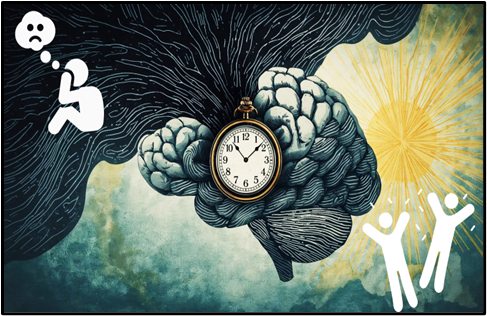
Neuroanatomist Jill Bolte Taylor discovered that the half-life of an emotion in the bloodstream (the chemical surge of anger or fear) lasts only 90 seconds. If you're still angry after a minute and a half, it's because you 've chosen to keep replaying the mental movie that makes you angry.
The Exercise: When you feel a negative emotion, look at the clock. You have 90 seconds of "immunity." Feel the chemistry rush. After that time, your old brain will want to keep projecting the image of the problem (e.g., an offensive email from a client).
The Action: Use your neocortex to "reframe." Force your mind to project a different, positive image (a recent accomplishment, the face of a loved one, a peaceful landscape). By changing the image, you cut off the chemical supply of the negative emotion.
2. Physiology before Psychology
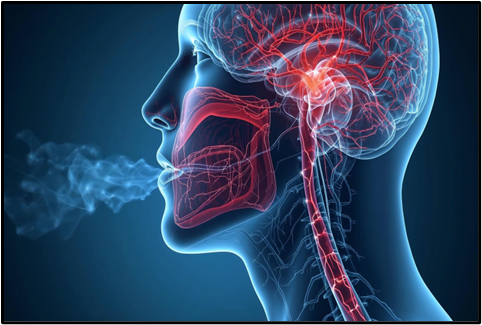
You can't "think" your way out of a stress attack, because when you're stressed, blood is diverted from the neocortex to the muscles (preparing you to fight or flee). You have to hack the system from within your body.
The Exercise: Before attempting to reason through a difficult problem, change your physiology.
The Action: Breathe. Take deep, slow breaths (inhale for 10 seconds, hold for 10 seconds, exhale for 10 seconds, hold your breath for 10 seconds, and repeat this cycle two more times).
This sends a signal through the vagus nerve indicating that "there is no lion chasing you." By calming the body, blood returns to the rational brain and you regain your intelligence.
3. Eliminating Harmful Dialogue: The Scientific Mind

The reptilian brain is dramatic; it loves to catastrophize ("Everything's going to go wrong," "I'm no good at this"). If you believe it, you lose. You must confront it with the scientific mind of your neocortex.
The Exercise: Detect automatic negative thinking.
The Action: Interrogate that thought like a rigorous scientist or a judge. Ask it: "What is the actual evidence that this is true?", "Is this a proven fact or just my assumption?", "What use is this thought right now?" . By analyzing the thought with cold logic, you defuse the emotional drama. Dismantle the lie with data.
4. Laser Focus: One thing at a time

Multitasking is a myth that exhausts the neocortex. The brain doesn't do two things at once; it just alternates between them very quickly, losing efficiency and increasing errors.
The Exercise: Train your attention like a muscle.
The Action: When you decide to work on a strength or task, eliminate everything else. If you're listening to someone, just listen (don't look at your phone). If you're analyzing a report, just analyze it. By focusing the neocortex on a single point, its power multiplies, and you enter a state of flow, where real learning occurs.
Recommendations for a "High-Performance Brain"

In addition to the exercises mentioned above, for the machine to function properly, we need basic maintenance. These are the keys to a brain capable of change:
Strategic nutrition: Eat less and better (moderate calorie restriction promotes neurogenesis).
Daily physical activity: Exercise oxygenates the brain and reduces cortisol.
Mental gymnastics: Learning new things forces the neural network to create connections.
Sleep hygiene: Sleeping 7-8 hours is non-negotiable; it's when the brain "cleanses" itself.
Gratitude: A daily exercise that refocuses attention on what is constructive.
Conclusion: The Freedom to Be
We are not marked for life. Talents are the starting point, but strengths are the path.
The next time you feel like you're losing control, remember: you have 90 seconds, you have your breath, and you have a scientific mind capable of questioning the drama. Developing your soft skills and redefining your life strategy isn't a gift reserved for a select few.
It's a decision for the Higher Management of your own mind. And you, what will you decide today?
Juan Carlos Erdozáin
Senior Management Advisor
THANK YOU FOR THE PRIVILEGE OF YOUR TIME

BIBLIOGRAPHIC REFERENCES
Fuster, JM (2014). Brain and freedom: The brain foundations of our capacity to choose . Ariel Publishing.
Obregón, C. (n.d.). Contributions in the context of contemporary humanism . [Unpublished manuscript].
Seligman, MEP (2002). Authentic Happiness (M. Diago & A. Debrito, Trans.). Ediciones B. (Original work published in 2002: Authentic Happiness ).
Taylor, JB (2009). A Stroke of Insight: A Personal Journey of Self-Improvement (JA Bravo, Trans.). Debate. (Original work published in 2006: My Stroke of Insight ).
Zabalo, J. (2021, February 7). Joaquín M. Fuster, eminent neuroscientist and humanist. The New Barcelona Post . Retrieved from https://www.thenewbarcelonapost.com/joaquin-m-fuster-eminente-neurocientifico-humanista/



Comments